Friday, October 16, 2009

Friday Oct 16 - PBI FALL 09 Project Development and Field Experience

Course Syllabus: PBI FALL 09 Project Development and Field Experience

Enacted Curriculum: Lesson planning. Students were given the class time to work with TAs and master teachers. Roberto Castenada was a guest master teacher with Math experience. Class began by returning revised concept maps for their Projects. They were also given hard copies of a lesson planning template. Students then began identifying specific lessons (benchmark and investigations) that would be needed during the development of their project based unit. Students made excellent progress and seemed to realize how “lessons” fit into a project as scaffolding and that they would not necessarily create all of the lessons that would be needed to implement their projects. Students were instructed to consider these lessons as potential stand alone lessons that they will be able to use during apprentice teaching and beyond.

Next students were put into their Field teams. They then worked on their three-day planner for the field experience (two days in the classroom followed by one day in the field). Students turned in what they had thus far for the three-day planner. These will be evaluated and returned to students for editing and revisions to submit to classroom teachers at the end of next week.


Picture: Using a GPS system in the field. This particular system can then hook up via the Internet to GoogleMaps and tell you exactly where you are and where you went.

Wednesday, October 14, 2009

Wednesday October 14 - MID TERM EXAM

Course Syllabus: MID TERM EXAM (take home)

Enacted Curriculum: Cooperative Learning and Problem Based Scenarios: Student are introduced to the differences between problem based scenarios and project based units. The idea that problem based scenarios can be used as scaffolds within projects or as stand alone lessons for “outlier” standards.

Students are introduced to structures which can be used to make problem based scenario using groups. Each member of the group is given a specific color of pen with which to write thus allowing the teacher to monitor who is contributing to the solving of the problem. Also students are introduced to how to conduct a Know/Need to Know assessment as part of a problem based scenario.

The culminating discussion is about assessment during a problem based scenario as well as how to expand or elaborate a relatively straight forward problem based scenario into even more complex problem.


Picture: Use of the Blanton Museum on campus for some PBI units ideas.

Monday, October 12, 2009

Monday October 12 - Collaboration in PBI STEM

Course Syllabus: Collaboration in PBI STEM (Krajcik Chapter 5)

Enacted Curriculum: Master Teacher Denise Ekberg began class by explaining the math and science classroom schedules at Bedicheck Middle School. PBI students signed up for teaching slots to launch their mini-projects the week before the field investigation.

Then, Professor Petrosino lectured on cooperative learning and ideas for effective practice in PBI STEM classrooms. He emphasized the role of teacher as designer and discussed definitions and traits of cooperative learning, ways of structuring interdependence (common goal, joint rewards, divided resources, complimentary roles), ways to assess and ensure individual accountability, and the importance of providing opportunities for group processing. The information provided in the PowerPoint presentation is based upon the “Learning Together” model developed by Johnson, D., Johnson, R. & Holubec, E. (1988). Circles of Learning: Cooperation in the Classroom. Edina, MN: Interaction Book Company.

Friday, October 9, 2009

Friday October 9 - PBI FALL 09 Project Development and Field Experience

Course Syllabus: PBI FALL 09 Project Development and Field Experience

Enacted Syllabus: Professor Petrosino showed a video about a PBI field trip to the coast. The class discussed key components of PBI, the role of field experiences, challenges with field trips, and ways to potentially overcome those challenges. The video is professionally edited and includes comments by Dr. Petrosino, Dr. Joe Polman, and Dr. Gail Dickinson concerning field experiences in project based instruction.

After the video, Dr. Petrosino had 2 challenge questions. Question 1 asked "What are the key components of project based instruction?" and Question 2 asked "What challenges are there to incorporating field experiences in project based instruction?" We then broke the class up into pairs of 2 in order to discuss their responses.


Wednesday, October 7, 2009

Wednesday October 7 - Collaboration in PBI STEM

Course Syllabus: Collaboration in PBI STEM (Krajcik Chapter 5)

Enacted Curriculum: Planning investigations, what are the large ideas for your field experience?

Monday, October 5, 2009

Monday October 5 - Scientific Investigations and Their Development

Course Syllabus: Scientific Investigations and Their Development (Kjajcik Chapter 4)


Enacted Syllabus: Continue Concept maps of Projects an Intro to Benchmark/Investigation lessons: Students are issued a handout summarizing the benchmark/investigation cycle that they will use in planning their PBI unit.


Picture: Aligning measurement with topographic map readings- McKinney State Falls Park, TX

Friday, October 2, 2009

Friday October 2 - PBI FALL 09 Project Development and Field Experience

Course Syllabus: See PBI FALL 09 Project Development and Field Experience

Enacted Curriculum: Continued from Wednesday, students use their project map to begin building a concept map for their project.

· Build a [draft] concept map of the knowledge and skills your students should

o Know BEFORE beginning your project

o Develop DURING the project

o Demonstrate AFTER the project is completed

o Begin to identify concepts that will require either a benchmark or investigation lesson. A specific lesson for that concept or concepts.

Evaluate your concept map.

· Help you define what students will need to know and what they will learn during the project?

· Describe links between concepts?

· Rank terms, topics and concepts in a hierarchy?

· Demonstrate a linear sequence or structure?

· Show interconnections between all related terms in a web? VERBS

· Decide what Benchmark lessons and investigations you need to plan for your unit?

Wednesday, September 30, 2009

Wednesday September 30 - Scientific Investigations and Their Development

Course Syllabus: Scientific Investigations and Their Development


Enacted Curriculum: Mapping your Project

PBL: pp 83

n Beginning = DQ

n Finish = Project

n List or include milestones, pieces of project, drafts etc.

You may want to write each component of the map on a post it and have the ability to rearrange as you go.

q Visit “Theory Behind Concept Map Making…” site first,

http://cmap.ihmc.us/Publications/ResearchPapers/TheoryCmaps/TheoryUnderlyingConceptMaps.htm

q Go to http://cmap.ihmc.us/

n Download CMAP tools to use in creating your draft concept map for your Driving Question


Picture: Student work from Sept 30, 2009

Monday, September 28, 2009

Monday September 28 - Developing Driving Questions

Course Syllabus: Developing Driving Questions

Enacted Curriculum: There was a class discussion about the field experience. The students were given three-day planning documents to begin the process of planning. Students were encouraged to begin by backward design by first thinking about the BIG enduring concepts they wish for their students to master through this project, and then thinking about what deliverable will assist in this. The planning document has spaces for students to fill out how they plan to launch their mini-project, the driving question, student objectives, TEKS, how they will get to know their students and foster a sense of community, how they will prepare their students for the field experience, inquiries/investigations, student artifacts / assessments, and resources. The first draft of the three-day planner is due on 10/16. After receiving feedback from the master teacher and TAs, students will submit their second draft to their cooperating teachers.

Saturday, September 26, 2009

Saturday September 26- Field Experience (McKinney Falls – Blanton))

Course Syllabus: Nothing Listed in Course Syllabus

Enacted Curriculum: Saturday September 26 (McKinney Falls – JG & BMA - MC)

PBI participants and special guests (including UTeach Master Teachers, the UTeach Laboratory/Technical Services Supervisor, and a PBI graduate there to share her PBI field experience) went to McKinney Falls State Park to explore and collaborate about field teaching opportunities and potential mini-projects. After a whole group orientation hike from the Upper to the Lower Falls, the students were able to choose to participate in one of three field investigations in order to gain deeper understanding of approaches to engaging students in problem-based field inquiries: Estimating and Measuring Stream Flow, Mapping/Topography, and Monitoring Water Quality (Bioassessment and Chemistry). During lunch, students decided whether to plan their field investigations at McKinney Falls or the Blanton Museum of Art. They determined what problem or challenge they plan to pose to their students, what field sites will facilitate their students’ work, what they want for the students to do, what resources they need, what they would like for their students to get out of the experience, and how they will scaffold student learning.

Enacted Curriculum: Blanton Museum

Introduction from Jennifer Garner – Teaching in a gallery setting

Early development of field lessons

Fill out Saturday lesson document

Gallery time, look at works to use in projects

Discussion about lessons in the E-Lounge


Friday, September 25, 2009

Friday September 25- Visit to the Blanton

The entire class (both morning and afternoon sections) went to the Blanton Museum of Art from 2:30-5:00. After a short introduction, the class split into two groups to have an introduction to the museum. The first group went with Jennifer Garner (BMA outreach/education), who introduced general museum concepts and had PBI participants perform activities that students may perform during a visit. The second group went to three different galleries with Matt Chalker, who demonstrated the use of concept cards. Participants were given cards with scientific/math terms written on them (such as chemistry, graphing, scientific notation, symmetry, etc.) and then had to find examples of the terms being referenced in pieces of art in the gallery. Once each group was finished, they swapped guides. Following the time inside the galleries, everyone took a short walk outside to see some permanent installations that may be able to be used when they return to the Blanton for the field projects.

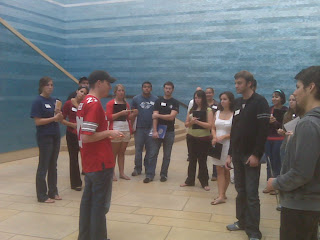
Picture: Students meeting in the lobby of the Blanton Art Museum on the campus of The University of Texas at Austin (Sept 25, 2009).

Friday September 25 - PBI FALL 09 Project Development and Field Experience

Course Syllabus: PBI FALL 09 Project Development and Field Experience

Enacted Curriculum: During class, students received group contracts (to negotiate their group goals and how they will hold each other accountable) and Project Planning forms from the PBL handbook. The students will use these documents to summarize the big ideas for their project; identify content standards, key skills, and habits of mind the students will learn; plan the assessment (define products and artifacts for the project); map the overall project and what they expect the students to learn; and identify potential problems that might arise and describe how they will manage the process. Students worked in their teams to write their driving question on a poster along with a description of what the student generated final product might be. Each team hung their poster on the wall and everyone circulated the room with post-it notes to provide feedback to each team. The teams were able to use this feedback to refine their driving questions.


BMA (MC)