Sunday, January 31, 2010

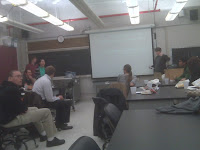
Meeting with Manor Teachers- Thursday Jan 28

Today we met with teachers from Manor New Technology High School in Manor, Texas. Manor New Tech, built on the New Technology Foundation model of project-based learning, is strikingly different from what is found in traditional secondary education classroom settings. MNTHS student population is made up of applicants accepted through a blind lottery. As a result, the student population at MNTHS is diverse in all aspects, including the two largest subpopulations of young men and young women of color. Additionally, the project-based learning environment sets up an atmosphere where learning is student-driven, engaging, and meets the needs of a wide variety of academic abilities. 

This semester I will be working with the following teachers---Tara Craig (Geogebra), Chris Fancher (Geogebra), Kyle Kendrick (Env. Sys/Stats), Heather Crouch (Env. Sys/Stats), Paige Sartin (Chem/Bio), Stephanie Hart (Chem), Pedro Merced (Math working with TAKS prep), Bobby Garcia (Engineering), Janice Trinidad (Phys/Alg 2). Missing from today's meeting but part of the group will be Sara Hawkins (Bio) and Floyd Banks (phys/Alg 2). 

In addition to myself, we also had Denise Ekberg (Clinical Faculty), Cesar Delgado (Assistant Professor), and Teddy Chao (Teaching Assistant) in attendance from UT. Matt Chankin (Teaching Assistant) was unable to make it today but is part of the group at UT as well. 

We had a great meeting and discussed some ideas for the field component for this semester's Project Based Instruction class at UT. 

Wednesday, January 27, 2010

SPG 2001- Day 3 January 27


Today, Profesor Petrosino started the class by giving student the same quiz from the very first day of class, this time as a post-test of their factual knowledge to solve the Circumference of the Earth problem. The class average for the pre-test from the first day was 95% and the class average for the post-test after working with the actual problem was a 98.1%, showing a mild increase.

Professor Petrosino then opened up a class discussion about why students did so well on test of individual facts, but not so well on actually finding the circumference of the Earth even though they knew all the facts. After all, if problem based learning was so good in terms of helping students connect their factual knowledge to actual concepts, then why is what we’re seeing when we visit actual classrooms more aligned with the factual recall quiz questions rather than the deep concepts from the problem? After some thoughts by the students, Professor Petrosino posed that, perhaps it’s the fault of all of us in the room. This class, and the UTeach cohort in general, is filled with students who have excelled in math and science, namely because we’ve done well at these sorts of factual recall based tests. All of us, including the Professor Petrosino, have been systemized to teaching and learning math and science into bite-size factual chunks.

Professor Petrsoino then started to talk about how we know that experts and novices in fact hold the same sorts of factual and often conceptual knowledge. But what differs in experts is their ability to transfer this knowledge to different situations. Students then broke up into smaller groups to discuss what they thought about this framework:  Is it possible to teach basic skills through complex problems? Or, is it more important to teach basic skills first before solving problems.

After the discussion, Master Teacher Denise Ekberg introduced the logistics of the Field Teaching Component of the course, in which students would be responsible for observations and implementation of a problem-based lesson at Manor New Tech High.

Tuesday, January 26, 2010

Supplement: June 19, 240 B.C.: The Earth Is Round, and It’s This Big

  • 12:00 am  |  
  • Categories: Uncategorized

    240 B.C.: Greek astronomer, geographer, mathematician and librarian Eratosthenes calculates the Earth’s circumference. His data was rough, but he wasn’t far off.


    Eratosthenes was an all-around guy, a Renaissance man centuries before the Renaissance. Some contemporaries called him Pentathalos, a champion of multiple skills. The breadth of his knowledge made him a natural for the post of librarian of the library of Alexandria, Egypt, the greatest repository of classical knowledge.


    His detractors, however, mocked Eratosthenes as a jack-of-all-trades and master of none. They called him Beta, because he came in second in every category.


    Envy? Perhaps. He invented the Sieve of Eratosthenes, an algorithm for finding prime numbers still used in modified form today. He sketched the course of the Nile from the sea to Khartoum, and he correctly predicted that the source of the great, life-giving river would be found in great upland lakes.
    Eratosthenes knew that at noon on the day of the summer solstice, the sun was observed to be directly overhead at Syene (modern-day Aswan): You could see it from the bottom of a deep well, and a sundial cast no shadow. Yet, to the north at Alexandria, a sundial cast a shadow even at the solstice midday, because the sun was not directly overhead there. Therefore, the Earth must be round — already conventionally believed by the astronomers of his day.


    What’s more, if one assumed the sun to be sufficiently far away to be casting parallel rays at Syene and Alexandria, it would be possible to figure out the Earth’s circumference. Eratosthenes computed the shadow in Alexandria to be 1/50 of a full 360-degree circle. He then estimated the distance between the two locations and multiplied by 50 to derive the circumference.


    Of course, his measurements were slightly off. Alexandria was not due north of Syene, but 2 degrees of longitude off. Syene was not precisely on the Tropic of Cancer but 39 minutes of latitude north of it. The distance between the cities was an estimate. The Earth is not a perfect sphere, but an oblate spheroid flattened at the poles.


    And we don’t know today the exact size of the measurement unit Eratosthenes was using when he came up with the final figure of 252,000 stades. (We know he knew it was just a rough estimate, because he adjusted his initial number of 250,000 upward by 2,000 — or 0.8 percent — to make it divisible by 60 or 360 for easy computation.)


    So how big is 252,000 stades? Depending on which classical source you trust, it’s somewhere between 24,663 and 27,967 miles. The accepted figure for equatorial circumference today is 24,902 miles. Pretty darn good for a guy without modern measurement tools.


    Eratosthenes went further and computed the tilt of the Earth’s axis to within a degree. He also deduced the length of the year as 365¼ days. He suggested that calendars should have a leap day every fourth year, an idea taken up two centuries later by Julius Caesar.


    Grade-school tales aside, it was thus known long before Columbus that the Earth was round and even how big it is, approximately. But it was just not widely known among the masses in 15th-century Europe. One reason is that Eratosthenes’ very own library of Alexandria had been destroyed, and there was no complete backup of its data.


    SPG 2010 Class 2- January 25, 2010

    Today was the second class day of the PBI course for the Spring 2010 semester of class. Professor Petrosino opened the class by telling a heartfelt story about his childhood love of the then Baltimore, now Indianapolis, Colts – based entirely upon an aunt’s gift of a Colts football helmet when he was 4 years old. The story culminated with his excitement that the Indiapolis Colts beat the New York Jets last night to return to advance to Super Bowl XLIV, a nice win against the old rival who beat them back in 1969 during Super Bowl III. Although he does have a soft spot for the NY Jets- thus making yesterday's victory a more subdued for him than expected. 


    The class continued with Professor Petrosino breaking the class up into groups of three students each to solve how Eratosthenes figured out the circumference of the Earth. Eratosthenes was able to calculate this number to only an error of a few percent, knowing only that, at noon, a meter stick in Syene cast no shadow while a meter stick in Alexandria, roughly 800 km away, cast a shadow of 0.1219 meters.


    In each group, two students were assigned to work together to solve the problem. The third member, however, was to observe the interactions of the other members of the group during problem solving, paying careful attention to four aspects: Discourse, Inscriptions, Engagement, and Learning. 


    While Professor Petrosino introduced this problem to the groups, Teddy Chao, the teaching assistant for the course, took the observers outside the classroom to discuss the particulars of the role of observer.


    Then, the groups were given about 30 minutes to solve the problem, with the observer taking notes and not participating in the problem solving in any way. At the end of the 30 minutes, Teddy once again met with the observers outside of the classroom to listen to what they had observed.


    Students then re-grouped to present their strategies and thinking on the doccam to the rest of the classroom. Professor Petrosino elicited students’ thinking and representations throughout the process, and then opened up space for the observers to add what they observed and interpreted was happening during the problem-solving process.


    Professor Petrosino then handed out a packet of various Middle School Science TEKS that showcased how the Circumference of the Earth activity involved multiple standards in deep ways.


    And, as the class came to a close, Professor Petrosino reminded students that two Discussion Board postings were due on the class website before Wednesday’s class.


    The purpose of the class is to set up a couple of discussions that will continue throughout the course, including:

    1) a clear example of inert knowledge

    2) modeling how motivating cross-discipline problems can be used in class. 

    3) development of observational skills related around ill structured and extended problem solving

    4) discussion of assessment practices. 

    5) showing how extended activities extend over a fair amount of curricula standards (TEKS).

    ----------------

    Eratosthenes and the The Circumference of the Earth

     Eratosthenes,  an ancient astronomer, historian, geographer, philosopher and mathematician, was also the directore of the great library of Alexandria. One day he read that in the southern frontier outpost of Syene, near the first cataract (waterfall) of the Nile, at noon on June 21 vertical sticks cast no shadows. This observation may have been easily past over by others but Eratosthenes was no ordinary guy. Eratosthenes had the presence of mind to conduct an experiment, actually to observe whether in Alexandria vertical sticks cast shadows near noon on June 21. And, he discovered that sticks do.

     Eratosthenes asked himself how, at the same moment, a meter stick (length = 1 meter) in Syene could cast no shadow and a stick in Alexandria, far to the north, could cast a shadow. Consider a map of ancient Egypt with two vertical sticks of equal length, one struck in Alexandria, the other in Syene. Suppose that, at a certain moment, each stick casts no shadow at all. This is perfectly easy to understand…provided the Earth is flat. Two shadows of equal length would make sense as well, since the Earth would be inclined at the same angle to the two sticks. But how could it be that at the same instant there was no shadow at Syene and a substantial shadow at Alexandria? The Earth must be curved…

     Eratosthenes figured out that the shadow length of the stick in Alexandria (in today’s terms, about .1219 meters or 4.8 inches). Eratosthenes also knew that the distance between Alexandria and Syene was (in today’s units) approximately 800 kilometers (@500 miles).

     Eratosthenes, using only sticks, eyes, feet, and brains (plus a taste for experiment) was able to deduce the circumference of the Earth with an error of only a few percent. How did he do it?  (no outside resource help on this one please)

    -----------------------------------


    Friday, January 22, 2010

    SPG 2010 Class 1- January 20, 2010

    Today was the first class day of the PBI course for the Spring 2010 semester of class. Professor Petrosino started the course off by introducing himself, Ms. Denise Ekberg, the master teacher, Teddy Chao, the course Teaching Assistant, Professor Cesar Delgado, who is teaching another section of the PBI course, and Matt Chalker, who is the TA for the other section of the course. Professor Petrosino then enacted an ice-breaker activity, grouping students up into pairs to discuss what they have liked and disliked about the UTeach program so far. Then, Professor Petrosino had students take a short quiz detailing isolated mathematical and scientific facts and procedure, in preparation for an activity in the next class involving finding the circumference of the Earth.

    Professor Petrosino then distributed the course syllabus, briefly outlining the three-tiered structure of the PBI course: 1) a theory driven perspective accounting for what we know of how people learn and how project-based instruction may be our best choice for bridging the gap between theory and practice, 2) a technological component that will assist the enrolled students in developing their own project-based unit, and 3) observation and teaching of well implemented project-based instruction in local schools will be coordinated with cooperating teachers in the local area school systems. To end the course, students took an online PBI captstone survey (http://www.surveymonkey.com/s/2rsrcpr) to elicit what sorts of prior knowledge students are bringing with them from earlier UTeach courses.

    Wednesday, January 13, 2010

    Obama References UTeach

    The following is a short write-up of a teacher training program in mathematics and science education that I am part of at The University of Texas at Austin. I've been involved for about 11 of the 12 years UTeach has been in existence and have created some of it's courses, lectured about it around the country and have studied it as part of my research. MANY of the components of what I learned with the UTeach Program were incorporated into the work with the Hoboken Curriculum Committee and Curriculum Project while I was Assistant to the Superintendent of Schools in Hoboken. In this excerpt, please read how President Obama finds the UTeach Program to be a great example of research and practice coming together in STEM Education. Over 50 Universities in the United States are using this model. -Dr. Petrosino
    ----------------------------------

    AUSTIN, Texas — At a special event at the White House today (Jan 6.), President Barack Obama recognized the national replication of The University of Texas at Austin's UTeach program and the supporters of that replication.
    "Our future depends on reaffirming America's role as the world's engine of scientific discovery and technological innovation, and that leadership tomorrow depends on how we educate our students today, especially in math, science, technology and engineering," said President Obama.

    In announcing the expansion of his "Educate to Innovate" campaign, the president applauded several new public-private partnerships that will help meet the goal of moving American students from the middle to the top in science and math achievement over the next decade.

    One of those exemplary partnerships is leading to the replication of the UTeach math and science teacher-preparation program, which began at The University of Texas at Austin in 1997, to 19 universities nationally.

    Thirteen universities in nine states implemented UTeach programs during the 2008-2009 school year. A newly announced second cohort of six universities includes the University of Tennessee Knoxville, Middle Tennessee State University, the University of Colorado at Colorado Springs, University of Texas at Arlington, University of Texas at Tyler and Cleveland State University.

    View a full list of UTeach replication sites.

    Support and funding for these replications come from the UTeach Institute, the National Math and Science Initiative, the Texas High School Project, the Texas Education Agency, the Greater Texas Foundation, Exxon Mobil Corporation, the Bill & Melinda Gates Foundation, the Michael & Susan Dell Foundation, Texas Instruments Foundation, the Tennessee Higher Education Commission, the Tennessee Department of Education and other private philanthropy.

    UTeach allows students to graduate in four years with both deep content knowledge in their major and a teaching certification. Ninety-two percent of UTeach graduates have become teachers, and 82 percent are still in the classroom after five years.

    Enrollment in UTeach has nearly doubled nationally in just two years, attracting more than 2,100 math and science majors into the program.

    Projections indicate that, by 2018, UTeach-like programs around the country will have produced an estimated 7,000 new math and science teachers, and those teachers will have affected more than one million students by 2017 and more than 20 million during the course of the new teachers' careers.

    At The University of Texas at Austin, UTeach has graduated more than 500 students, and has more than doubled the number of math majors and increased by six times the number of science majors being certified as teachers at the university.


    Tuesday, December 15, 2009

    Some UTeach PBI Modifications Currently Under Consideration

    The following are some possible modifications to UTeach PBI currently under consideration for the sections that I teach over the next couple of semesters. The idea is that there will be a fairly slow but consistent evolutionally modification to the course:

    1) modification to the field experience to be more consistent with PBI
    2) introduction of the LEGACY cycle for designing of a curriculum semester project
    3) addition of more substantive (in quality and quantity) course readings
    4) incorporation of engineering/STEM into the content of the course
    5) introduction of a formative assessment instrument to assess knowledge of previous UTeach course objectives upon entering PBI
    6) incorporation of mentorship activities with existing PBI teachers
    7) review by the students of some national PBI curriculum
    8) a section of the course dedicated to online teaching pedagogy
    9) utilization of in class survey's to provide regular feedback
    10) expansion of potential STEM faculty willing to teach PBI
    11) introduction of various lesson plan formats (other than 5E's)
    12) Learning progressions and educative curriculum incorporated (Cesar)
    13) More detailed discussions on the differences between: problem based learning, project based learning, case based learning, challenge based instruction, anchored instruction
    14) In class conducting of a project based unit (Mission to Mars)
    15) Instruction of class to include more opportunities for projects.

    Sunday, December 13, 2009

    Initial Thoughts on UTeach PBI Field Modifications

    Both of these attachments are taken from the UTeach Institute's Curriculum document.

    1) The first indicates my conjecture that PBI is the capstone course in the professional development sequence. Maybe people were speaking about AT as a capstone for the entire program? I'm not sure.

    2) The second item is the total FE hours that PBI students do for the course compared to other courses in the professional sequence. I spoke with many of the Local School teachers recently and they were uniform in their agreement that the field experiences in PBI were memorable and important...but they did not have much to do with PBI.

    By the SPG 2011 semester, PBI's FE will be in in synch with the other CoE courses. Roughly, they seem to average a little less than 2 FE hrs per course credit. I will shoot for PBI to be in the range of 6-8 hrs (well over 2 FE's per course credit). As things stand now, PBI has 3X more FE hrs than CI, and 4X more than the Step courses. This is clearly referenced in the description of PBI above, "immersion in intensive field-based experiences"-- We are trying to keep the concepts of "immersion" and "intensive" still in PBI, but they will be defined not by quantity but by quality. In the long run, this course will be better for the UTeach students we teach as it will reflect better what PBI is and is not. PBI is not a field based course. I think it's time we bring it more in line with the other CoE courses in terms of the proportion of hrs dedicated to an integration of theory and practice *ABOUT* PBI.

    I'm more confident than ever that by the end of the next 12 months (SPG 2011), PBI will become a course that multiple STEM professors will be able to teach. But, a reduction in quantity, not quality, of FE hours is very likely going to become a reality.

    To be clear, the field experiences students receive during PBI are clearly important, memorable, and worthwhile. They just don't belong in PBI. They belong in a course called something like "Conducting Field Based Teaching in STEM Education". In order for me and the team associated with PBI to make the modifications needed, less time is going to have to be dedicated to FE. Not surprisingly, students rate the field experiences as a highlight (even this past semester). I hope the UTeach program can keep this important aspect of the program intact. This really needs to be addressed at the program level and with the Steering Committee and I imagine other courses will need to pick up some of the lost PBI FE hours (K&L is currently listed have having none) or we'll officially have to reduce this number we claim. I think with almost a year to plan, something can be worked out. I will formally bring this up at the first or second SPG meeting of the Steering Committee.

    3) As an aside, when asked, the local Teachers said that Research Methods class (while excellent and important) did not prepare them to teach using project based instruction. They may have been referring to an older version of RM but their response was very uniform. I'm in contact with another researcher and plan on talking to her about her monograph...

    4) I'm in the process of preparing a document that will summarize much of the 3 meetings I had this week about PBI---but, I wanted to give a little heads-up on these three issues as I will not emphasize them too much in the report but wanted the two co-directors to have as much lead time on this as possible.

    5) I'll be meeting with members of the PBI team next week as we push forward.... I will also be bringing in some STEM faculty and other people in as the process progresses next semester.

    Friday, December 11, 2009

    December 11- Final Exam Section II

    Friday, December 11 was the final exam/presentations for Section 2 of out PBI course. Topics included invasive species, astronomy, pollution, endangered species-- Everything went well and students were generally relieved and excited about the prospect about being finished for the semester.

    December 10- Meeting at Manor New Tech

    On December 10, 2009, Denise Ekberg and Tony Petrosino met with about 10 teachers from Manor New Tech High School in Manor, TX (about 8 miles east of Austin). Manor New Tech is a high school that utilizes a version of project based instruction and includes a high proportion of former UTeach graduates.


    Manor New Tech Meeting
    December 10, 2009

    I. Introductions

    II. Discussion of Existing Relationship Between Manor and UTeach

    III. Purpose of this Meeting

    a. Short term goals (SPG 2010)
    - Observations
    - Semester Projects
    - Field Experiences

    b. Long term goals (Fall 2010 onward)

    IV. Seeking Mutually Beneficial Relationship- beneficial to all parties

    V. Next Meeting(s)

    Thursday, December 10, 2009

    Final Exam- Section 1

    On Wednesday evening from 7pm -10pm, Section 1 of PBI took their final exams. The exam was in the format of a presentation on the PBI unit that each group developed. Generally, there were teams of 4 students and they created a unit with an anchor video, a project calendar, lesson plans, resources, letters to parents, assessments, a summary paper and special modification for students. The exam was preceded by dinner and refreshments and teams were evaluated by peers, TA's, instructors of the course and even a visiting professor. The climate in the class was primarily one of celebration and relief. A great deal of coordination and collaboration was accomplished to finish this semester long project and with a full course load of intense classes, exam time can be stressful for anyone. But, presentations went well, comments were friendly and insightful and each group will receive substantial feedback on their project. Final grades are due early next week. The final exam for Section 2 will be on Friday from 2pm-5pm.

    Tuesday, December 8, 2009

    Dr. Allan Collins Visits UT- UTeach Lecture Series

    The following article appeared in The Daily Texan and was written by Vidushi Shrimali. Dr. Collins work has made significant impacts on education, artifical intelligence, and cognitive psychology. In addition to his lecture, Dr. Collins visited Dr. Joan Hughes Instructional Technology graduate course, met with numerous faculty members, and had wonderful interactions with some of our students. Please see his full bio at the end of this article. -Dr. Petrosino


    In an age where adults blame new gadgets and social networking sites as the cause for students’ misconduct and poor educational performance, Allan Collins, a professor at Northwestern University, is encouraging students and teachers to use iPhones and Web sites, including Facebook, not only as entertainment, but also in the classroom.

    Anthony Petrosino, a professor in the College of Education, asked Collins to speak at UT after he saw a posting on Collins’ Facebook page about his tour for “Rethinking Education in the Age of Technology,” a book Collins co-authored with peer Richard Halverson. Collins spoke at the University on Tuesday as part of UTeach’s Lecture Series.

    “[His book] spoke [about] a lot of issues and topics we are grappling with,” said Petrosino.

    “Collins’ work already has a huge influence on our graduate and undergraduate program. There are very few classes we offer in which an article by Dr. Collins is not present.”

    Collins spoke on the benefits of what he calls new education, a growing internal movement that turns to technology to provide individualized instruction.

    “We don’t let [students] use books, calculators or the Web when taking a test. But what matters in the real world is how well you can mobilize different sources like the Web to try to solve problems,” Collins said.

    Collins summarized the history of education in three eras.

    “In the apprenticeship era, education was personal, resource intensive, and engaging,” Collins said. “In the schooling era, education was mass-oriented, efficient and bureaucratic. In the lifelong-learning era, education is becoming customized, highly interactive and learner-controlled.” 

    In new education and virtual and online high schools and colleges like the University of Phoenix, books are at least supplemented, if not replaced, with the Web, and students are given more freedom to choose what they learn.

    Children as young as three or four years old use hand-held devices similar to the Kindle or iPhone, with stories, animations and voice recordings to practice reading skills, and students of all levels and ages have access to Web tutors and computer-based learning software that will allow them to work at their own pace and pursue individual interests.

    Collins suggested questioning the current education systems, including the system of a high school, and replacing them with home schooling or a form of more individualized education.

    “One of the problems with school is that we teach these things that in no context are relevant to real life,” Collins said. “Most students learn calculus and have no clue why they are going to use that in real life. I certainly didn’t and most teachers don’t.”

    Brad Armosky, an employee at the Texas Advanced Computing Center at the University, pointed out that university professors have the opportunity to pursue alternative teaching methods that elementary education teachers cannot.

    “At university, if a faculty member wants to try something new, if it works, great. If it doesn’t, faculty and students can make up for it, no harm done. K-12 teachers can’t afford to take such a risk. They can’t say, let me try something totally new, using a level of technology we can’t use. If it doesn’t work, the two, three days you invested in the present topic, the kids didn’t learn what they needed to learn. What are the repercussions of missing that piece of information?” Armosky said.

    -----------------------------

    Dr. Collins Bio: 

    Allan M. Collins is an American cognitive scientist and Professor Emeritus of Learning Sciences at Northwestern University's School of Education and Social Policy. Collins' research is recognized as having broad impact on the fields of cognitive psychology, artificial intelligence, and education.

    Psychology

    Collins is most well known in psychology for his foundational research on human semantic memory and cognition. Collins and colleagues, most notably M.R. Quillian and Elizabeth Loftus, developed the position that semantic knowledge is represented in stored category representations, linked together in a taxonomically organized processing hierarchy (see semantic networks). Support for their models came from a classic series of reaction-time experiments on human question answering.[1][2][3]


    Artificial Intelligence

    In artificial intelligence, Collins has been recognized for his work on intelligent tutoring systems and plausible reasoning. With collaborator Jaime Carbonell, Collins produced the first documented example of an intelligent tutor system called SCHOLAR CAI (computer-assisted instruction).[4]Knowledge in SCHOLAR was structured analogously to the then theorized organization of human semantic memory as to afford a variety of meaningful interactions with the system. Collins' extensive research program pioneered discourse analysis methods to study the strategies human tutors use to adapt their teaching to learners. In addition, Collins studied and developed a formal theory characterizing the variety of plausible inferences people use to ask questions about which their knowledge is incomplete. Importantly, Collins developed methods to embed lessons learned from such research into the SCHOLAR system, improving system usability and effectiveness. Subsequently, Collins developed WHY, an intelligent tutoring system that used the Socratic method for tutoring causal knowledge and reasoning. In conjunction with this project he developed a formal computational theory of Socratic tutoring, derived from analyses of inquiry teaching dialogues.


    Education

    As a cognitive scientist and foundational member of the field of the learning sciences, Collins has influenced several strands of educational research and development. Building upon his work on intelligent tutoring systems, Collins has conducted numerous projects investigating the use of technology in schools and developing educational technologies for assessing and improving student learning. Collins has gradually shifted towards the situated cognition view of knowledge being embedded in the activity, context, and culture in which it is developed and used. In response to conventional practices that often ignore the influence of culture and activity, Collins and colleagues have developed and studied cognitive apprenticeship as a effective alternative educational practice. In addition, Collins was among the first to advocate for and outline design-based research methodologies in education.


    Education and Professional Appointments


    Academic Honors and Service


    Noted and Representative Publications

    • Collins, A. M., & Quillian, M. R. (1969). Retrieval Time from Semantic Memory. Journal of Verbal Learning and Verbal Behavior, 8, 240-247. (citation classic)
    • Collins, A. M., & Loftus, E. F. (1975). A Spreading Activation Theory of Semantic Processing. Psychological Review, 82, 407-428. (citation classic)
    • Collins, A. M., & Michalski, R. S. (1989). The logic of plausible reasoning: A core theory. Cognitive Science, 13, 1-49.
    • Collins A. M., Brown J. S., & Newman S. (1989). Cognitive Apprenticeship: Teaching the Craft of Reading, Writing, and Mathematics, in Knowing, Learning and Instruction: Essays in Honor of Robert Glaser, edited by LB Resnick, Lawrence Erlbaum, Hillsdale, NJ.
    • Brown, J. S., Collins, A.M., & Duguid, P. (1989). Situated cognition and the culture of learning. Educational Researcher, 18 (1), 32–42.
    • Collins, A. M. (1992). Towards a design science of education. In E. Scanlon & T. O’Shea (Eds.), New directions in educational technology (pp. 15-22). Berlin: Springer.
    • Collins, A. M., & Ferguson, W. (1993). Epistemic forms and epistemic games: Structures and strategies to guide inquiry. Educational Psychologist, 28(1), 25-42.
    • Greeno, J., Collins, A. M., & Resnick, L. (1996). Cognition and learning. (pp. 15-46) In D. Berliner and R. Calfee (Eds.), Handbook of Educational Psychology. New York: Macmillan.
    • Bielaczyc, K. & Collins, A. M. (1999). Learning communities in classrooms: A reconceptualization of educational practice. In Reigeluth, C. M. (Ed), Instructional-design Theories and Models: A New Paradigm of Instructional Theory : 269-292.
    • Collins, A.M.; Joseph, D., & Bielaczyc, K. (2004). "Design research: Theoretical and methodological issues". Journal of the Learning Sciences13 (1): 15–42.


    Picture: Sara Young

    Allan Collins, professor emeritus at Northwestern University, spoke Tuesday about restructuring educational approaches to include current technologies in his “Rethinking Education in the Age of Technology” tour.